What is Energy Harvesting?
📖 What is Energy Harvesting? ▼
Energy harvesting (also known as power harvesting or ambient energy scavenging) is the process by which energy is derived, captured, and stored from external sources (e.g., solar power, thermal energy, wind energy, salinity gradients, and kinetic energy) for small, wireless autonomous devices used in wearable electronics and wireless sensor networks. Operating independently of macro electrical grids and conventional batteries, this technology provides wireless & batteryless autonomy across a wide spectrum ranging from aerospace to biomedical implants, consumer electronics, structural health monitoring, and industrial sensors.
Within the scope of Industry 4.0 and smart factories, energy harvesting powers wireless sensors by capturing micro-vibrations generated by machinery, waste heat from pipes, and factory lighting.
Micro-Vibrations
Converts micro-shocks of machinery and internal engine motions such as pistons in marine engines into kinetic energy.
Ambient Waste Heat
Converts temperature differences from waste heat sources on steam lines, pipes, motor bodies, and machine surfaces into electricity.
Indoor Factory Light
Continuously captures photons from fluorescent and artificial LED lighting.
This application completely eliminates power cabling installation costs and periodic chemical battery replacement operations (battery waste management and logistics labor) for thousands of sensors in industrial monitoring systems.
Energy Harvesting Technology Transcending Industrial Boundaries
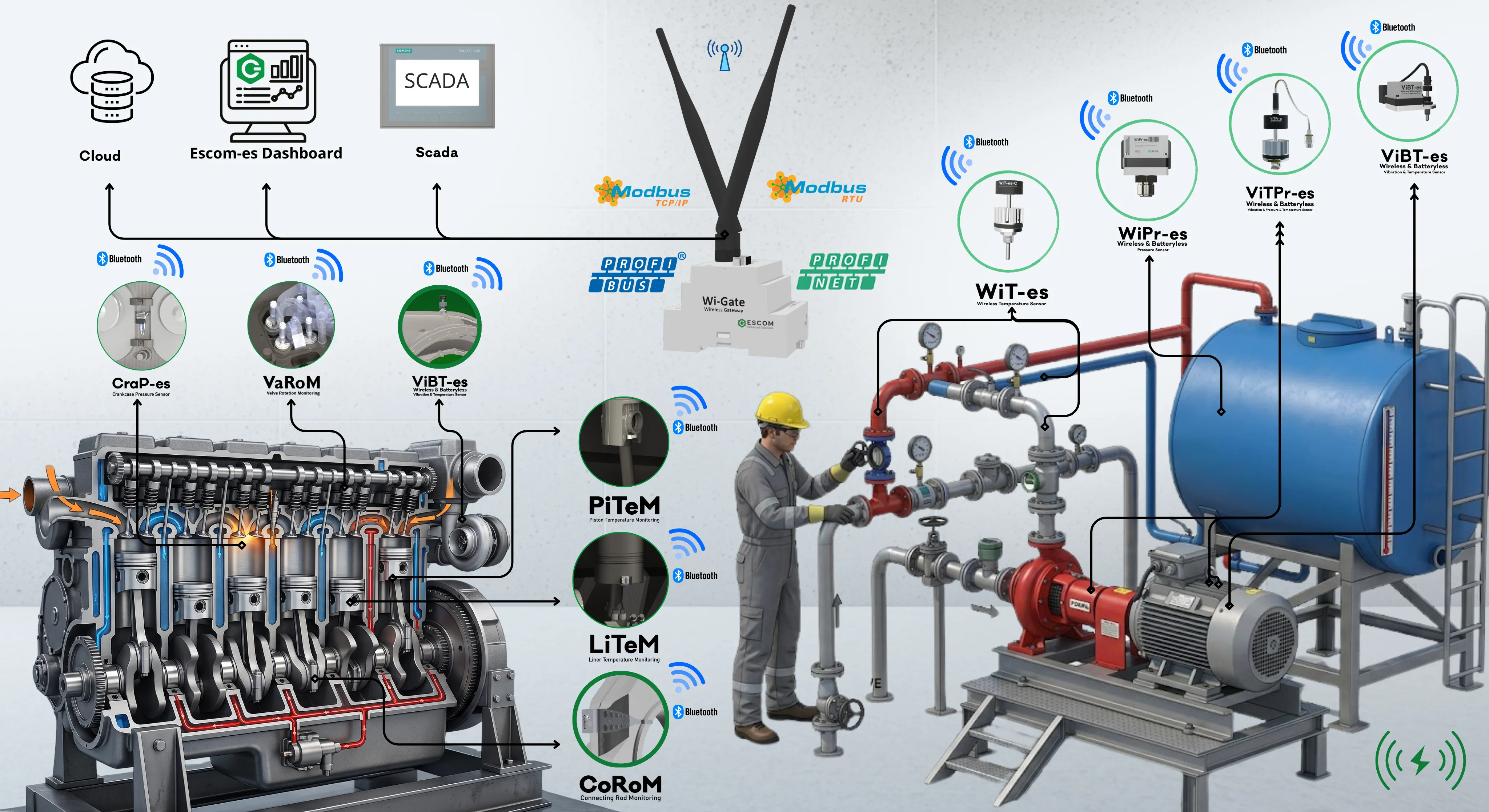
You don't always have to depend on a grid line, miles of cable, or batteries that need periodic replacement to access power. In fact, the power you need is already present in your facility; it's just waiting to be harvested correctly.
A temperature difference on a pipeline or the body of an operating motor, kinetic energy of moving parts inside a machine, or ambient light and electromagnetic waves... These are often unnoticed energy sources seen as 'lost' or 'waste'. As ESCOM-es, we capture this invisible yet powerful potential of nature and industry with high precision.
World Record Performance Parameters
ESCOM-es energy harvesting sensor architecture redefines global standards in power consumption and data transmission rates.
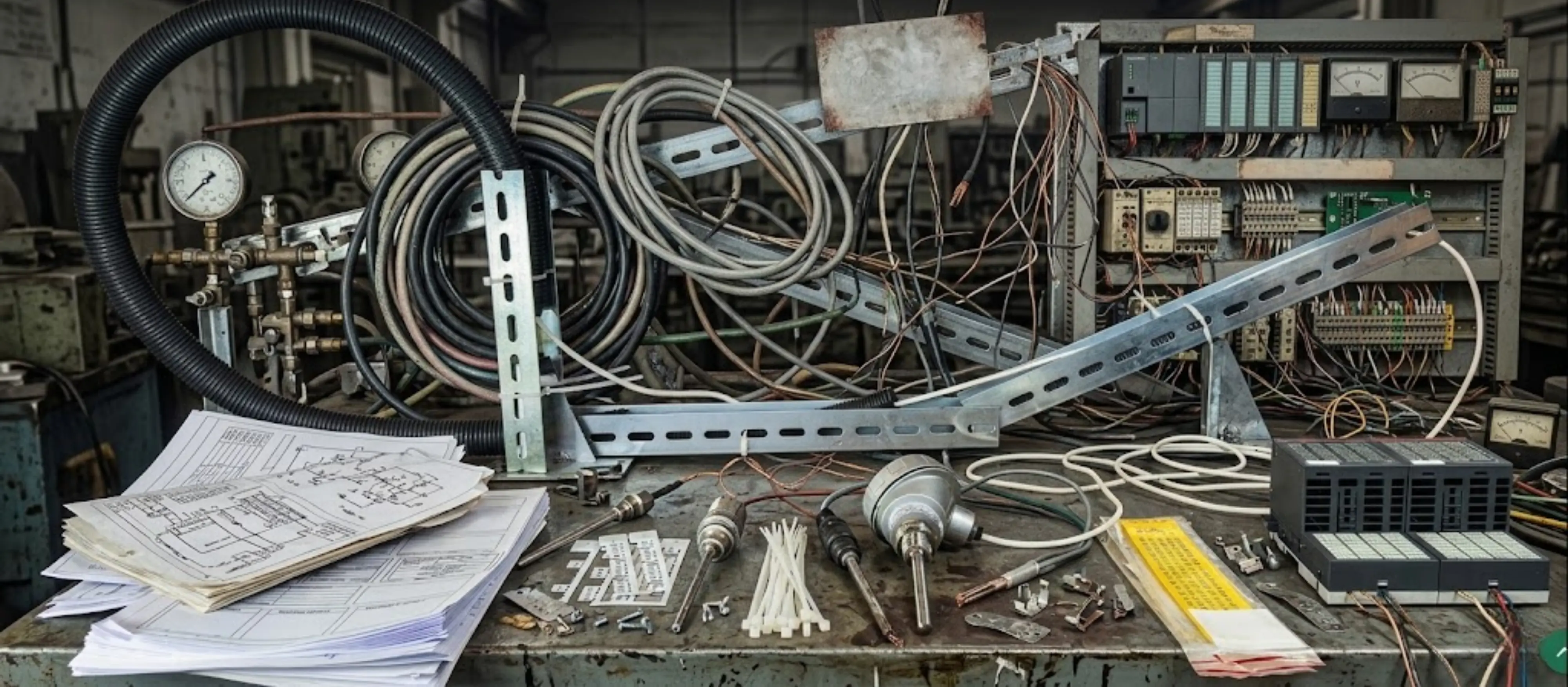 TRADITIONAL BURDEN
 Traditional Wired Sensor Infrastructure
Complex, costly infrastructure requiring meters of copper wiring, heavy metal cable trays, steel frame mountings, and extensive labor.
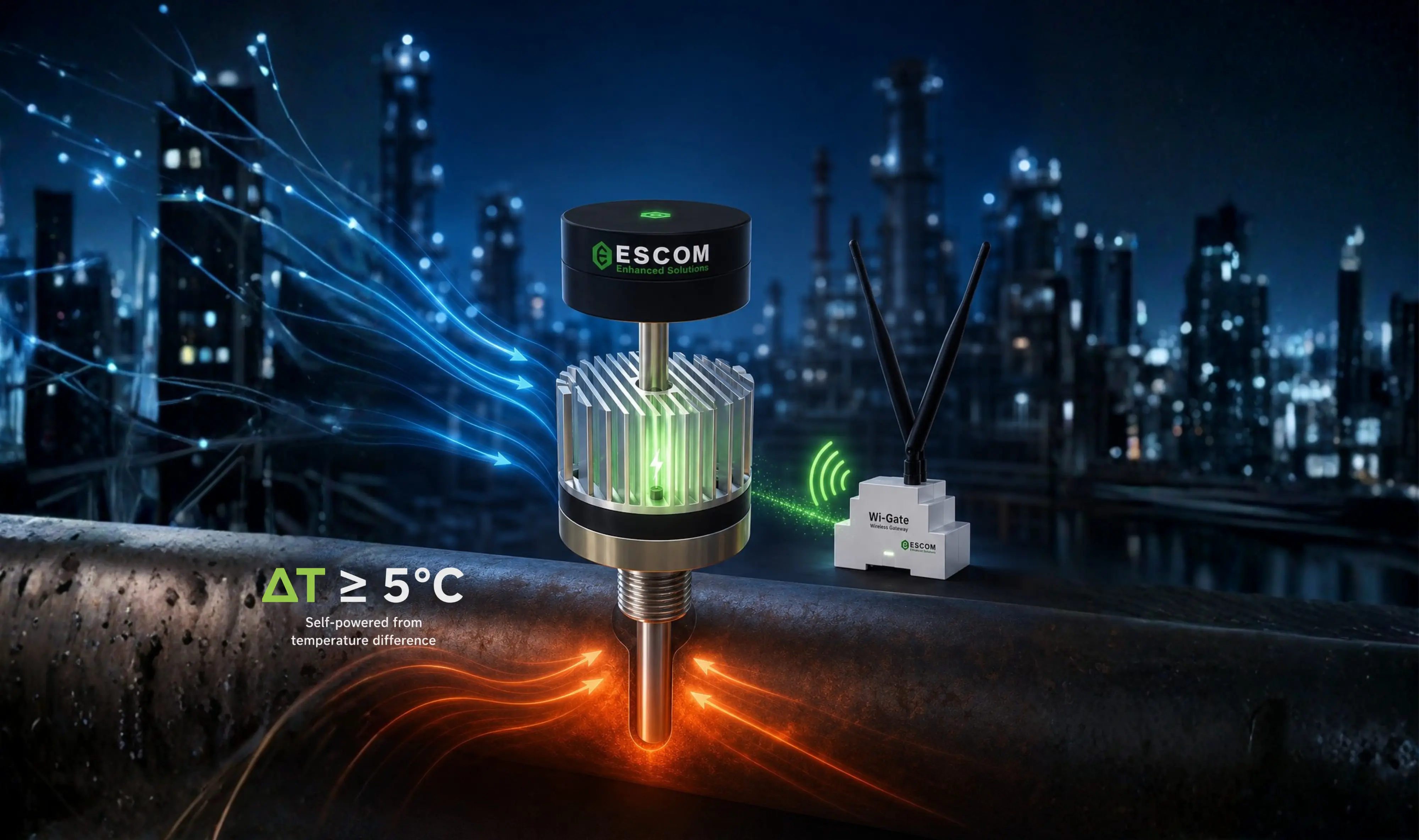 ESCOM-es HIGH-TECH
 ESCOM-es Wireless & Energy Harvesting Technology
Eliminates all cabling and battery maintenance by harvesting ambient waste energy:
Five Fundamental Energy Harvesting Types
Five core harvesting architectures capturing ambient waste energy in your plant with high stability. Expand to explore detailed technical methods, choices, and integration limits.
The process of directly converting ambient temperature differences (thermal gradients) into electrical power using solid-state semiconductor transducers based on Seebeck Effect principles.
🔍 Common Methods and Thermal Types
Operates via the Seebeck Effect. Directly generates DC voltage from temperature differences between semiconductor junctions. The most stable method for continuous heat.
Converts polarization changes caused by time-dependent temperature fluctuations into electricity. Cannot operate under constant temperatures.
Relies on reaction rates in liquid electrolytes under gradients. High risk of liquid leakage and corrosion in industrial facilities.
🏆 ESCOM-es Engineering Choice and Rationale
For 24/7 continuous operation and zero maintenance in harsh facilities, we avoid leak-prone thermogalvanic cells and fluctuation-dependent pyroelectric crystals. Instead, ESCOM-es selected a 100% solid-state ceramic Thermoelectric Generator (TEG) architecture. Because they suffer no mechanical wear, they eliminate leaks and offer long-term operational lifespan. Supported by our advanced cold-start EH-PMIC, they start operating at just ΔT ≥ 5°C.

Industrial Placement Locations: Steam distribution pipes, steam trap bodies, heat treatment furnace walls, hot pump/motor housings, exhaust manifold pipelines, and valve bodies carrying hot fluids.
Converting mechanical motion, vibrations, and resonance oscillations generated by rotating industrial machinery and motors into electricity using electromagnetic induction.
🔍 Common Methods and Kinetic Types
🏆 ESCOM-es Engineering Choice and Rationale
Fragile piezo-ceramics and voltage-prebiased electrostatic designs fail under violent g-forces and mechanical shocks found in power plant engine rooms and marine vessels. Therefore, ESCOM-es utilizes robust Electromagnetic Induction (magnet-coil) harvester modules in CoRoM and VaRoM. Tuned to machine resonance frequencies (15-100 Hz), our copper coil resonators generate stable EMF without mechanical contact, wear, or breakage risk.

Industrial Placement Locations: Large 4-stroke marine engine connecting rods and valve covers, pump motor bearings, cooling tower fan shafts, industrial compressor blocks, and conveyor drives.
Converting ambient artificial indoor lighting or natural sunlight photons into electrical energy using high-efficiency photovoltaic cells.
🔍 Common Methods and Light Types
High-efficiency Photovoltaic (PV) cell architecture that harvests electrical energy directly from natural sunlight or indoor room lighting.
Thin-film indoor cells engineered to operate under narrow-spectrum artificial illumination like factory LED and fluorescent lamps.
Next-generation cells utilizing photosynthetic dyes to produce electricity even in highly diffuse and extremely low-light environments.
🏆 ESCOM-es Engineering Innovation
For solar energy harvesting, ESCOM-es utilizes high-efficiency monocrystalline and indoor-optimized amorphous silicon Photovoltaic (PV) cell architectures. Our AiM and AiM-0 smart climate monitoring devices feature an adaptive power management architecture that automatically adjusts data transmission intervals between 3 and 75 seconds based on light intensity, backed by advanced supercapacitor storage. This enables them to operate continuously in pitch darkness for up to 1 week when factories or offices are closed.

Industrial Placement Locations: Ceilings beneath production floor lighting fixtures, control rooms, indoor storage areas, administrative areas, and any surface receiving light from fluorescent or LED fixtures.
Capturing ambient radio waves in the air (Wi-Fi, GSM, LoRa, Bluetooth) using specialized rectifying antennas (rectenna) and converting them into stable DC power.
🔍 Common Methods and RF Types
Captures airborne radio frequency waves and rectifies them into DC power via integrated rectifier circuits or magnetic transformer coupling.
Circuits engineered to wake from millivolt-level micro-excitation voltages to harvest energy from ambient RF waves.

Industrial Placement Locations: Proximity to industrial Wi-Fi routers and LoRaWAN gateways, areas adjacent to radio broadcast stations, and high electromagnetic noise sectors.
Capturing electromagnetic induction flux generated around alternating current (AC) lines using split-core coil clamps and converting it into electricity.
🔍 Common Methods and Magnetic Types
Non-contact split-core clamp clipped around active AC power cables to capture changing magnetic flux without cutting the wire.
Induces voltage via leakage magnetic fields or variable flux based on AC transformer principles.
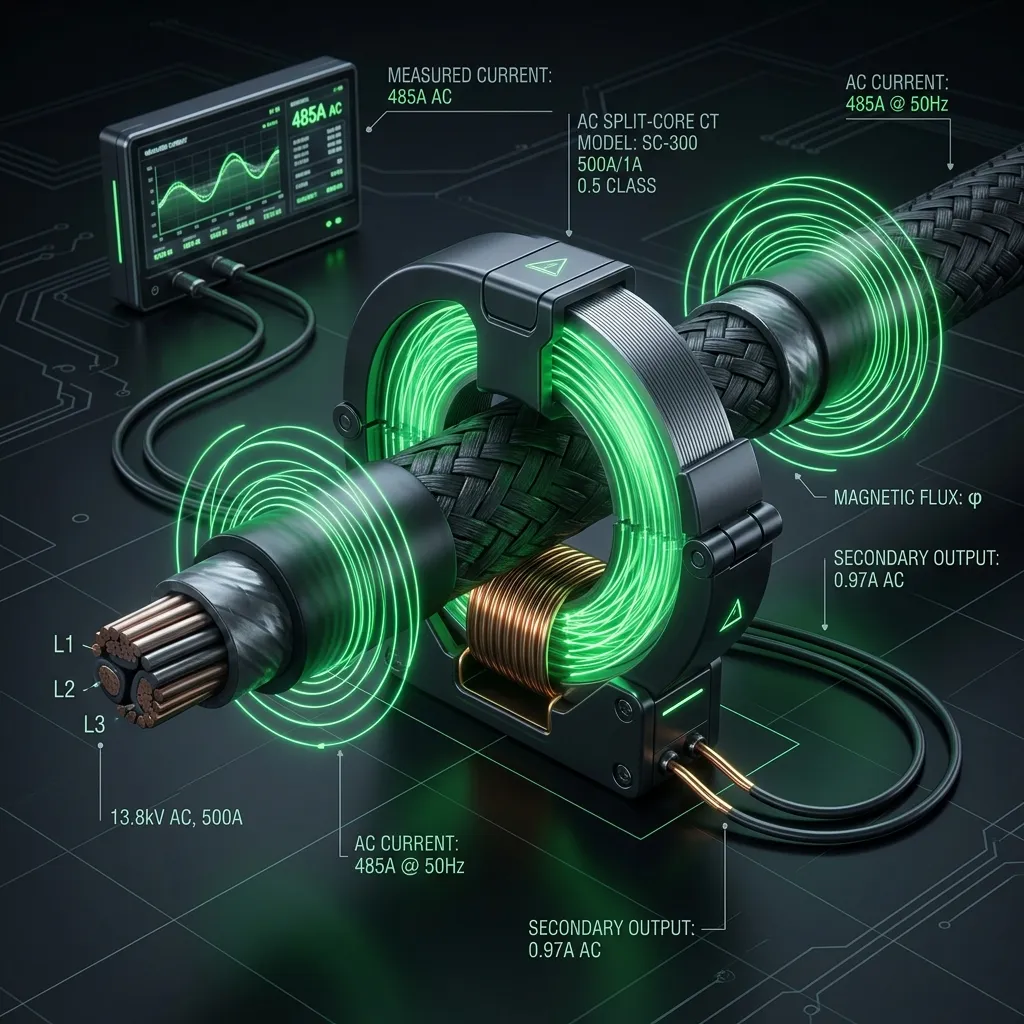
Industrial Placement Locations: Main feeder cables inside power distribution switchboards, AC supply lines of high-voltage electric motors, compressor supply cables, and transformer busbars.
True TCO and Energy Harvesting Solution in Industrial IoT Investments (McKinsey Analysis)
📊 10-Year Field Operations & Sustainability Simulator
Slide to adjust your factory sensors and cabling parameters to view operational and environmental savings in real-time:
Traditional Wired / Battery Burden
- ❌ Costly production shutdowns required for tray routing and wiring
- ❌ Unpredictable battery depletions causing critical telemetry gaps
- ❌ Chemical battery waste management and environmental compliance penalties
ESCOM-es Batteryless Wireless Solution
- ✅ Plug-and-Forget: Rapid commissioning without site shutdowns
- ✅ Infinite Life: 24/7 continuous telemetry powered entirely by ambient energy
- ✅ Carbon-Neutral: Direct contributions to ESG metrics and corporate goals
* Baseline Parameters: Wired calculations assume typical tray routing and wiring labor; battery calculations assume a traditional industrial wireless sensor with a 2.5-year battery life.
Lost Industrial Data
Percentage of raw industrial machinery data lost due to traditional cabling limitations and manual audits.
CapEx Installation Savings
Initial CapEx savings achieved by eliminating cable conduits, specialized labor, and installation downtime.
10x Faster ROI
By preventing a single critical machine failure or line shutdown, batteryless sensor systems accelerate Return on Investment (ROI) over 10x faster than wired networks.
⏱️ Financial Value & Failure Prevention Roadmap
Day 1: CapEx Savings
Deploy in minutes without cabling or production shutdowns. Saves 90% of wiring and tray installation costs on day one.
First Event: Critical Failure Avoidance
Preventing a single steam leak or mechanical bearing seizure avoids catastrophic shutdown costs, paying back the entire investment instantly.
Perpetual: Zero Batteries, Zero Maintenance
Eliminate battery replacement logistics and wiring failure audits entirely. Enjoy autonomous, self-powered telemetry for the lifetime of your machinery.
Where is Energy Harvesting Used in Industry?
Key deployment scenarios in your plant where ambient waste energy powers continuous, batteryless telemetry.
1. Hot Steam and Condensate Lines (Thermal)
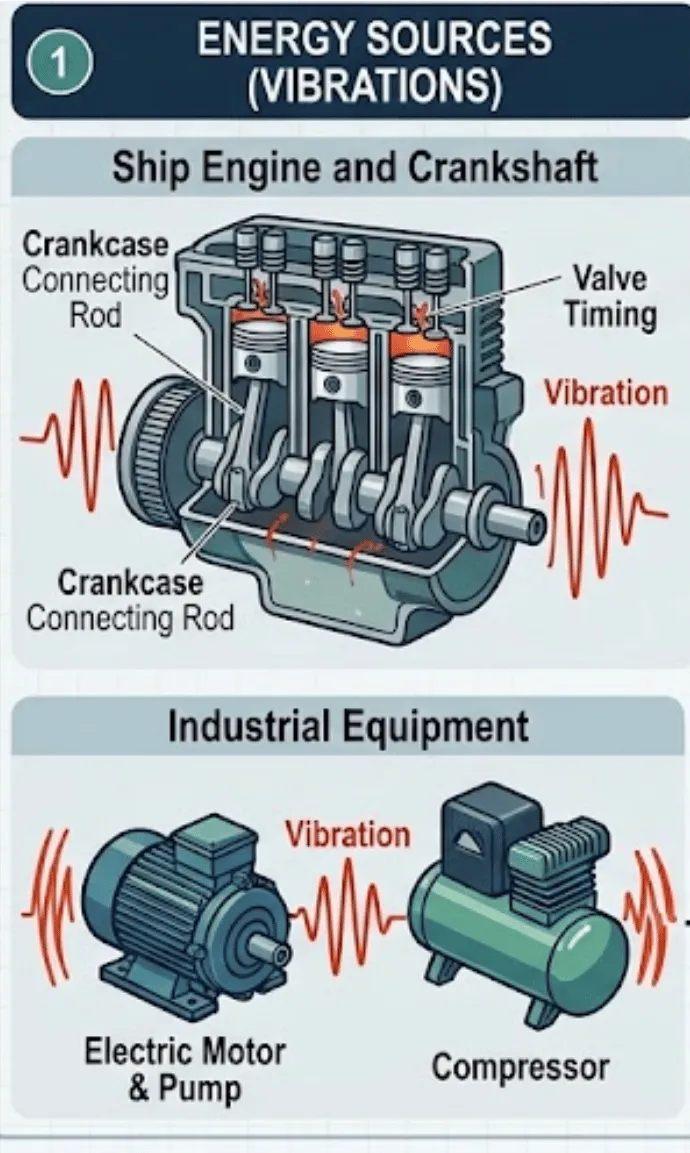
2. Vibrating Motors and Compressors (Kinetic)
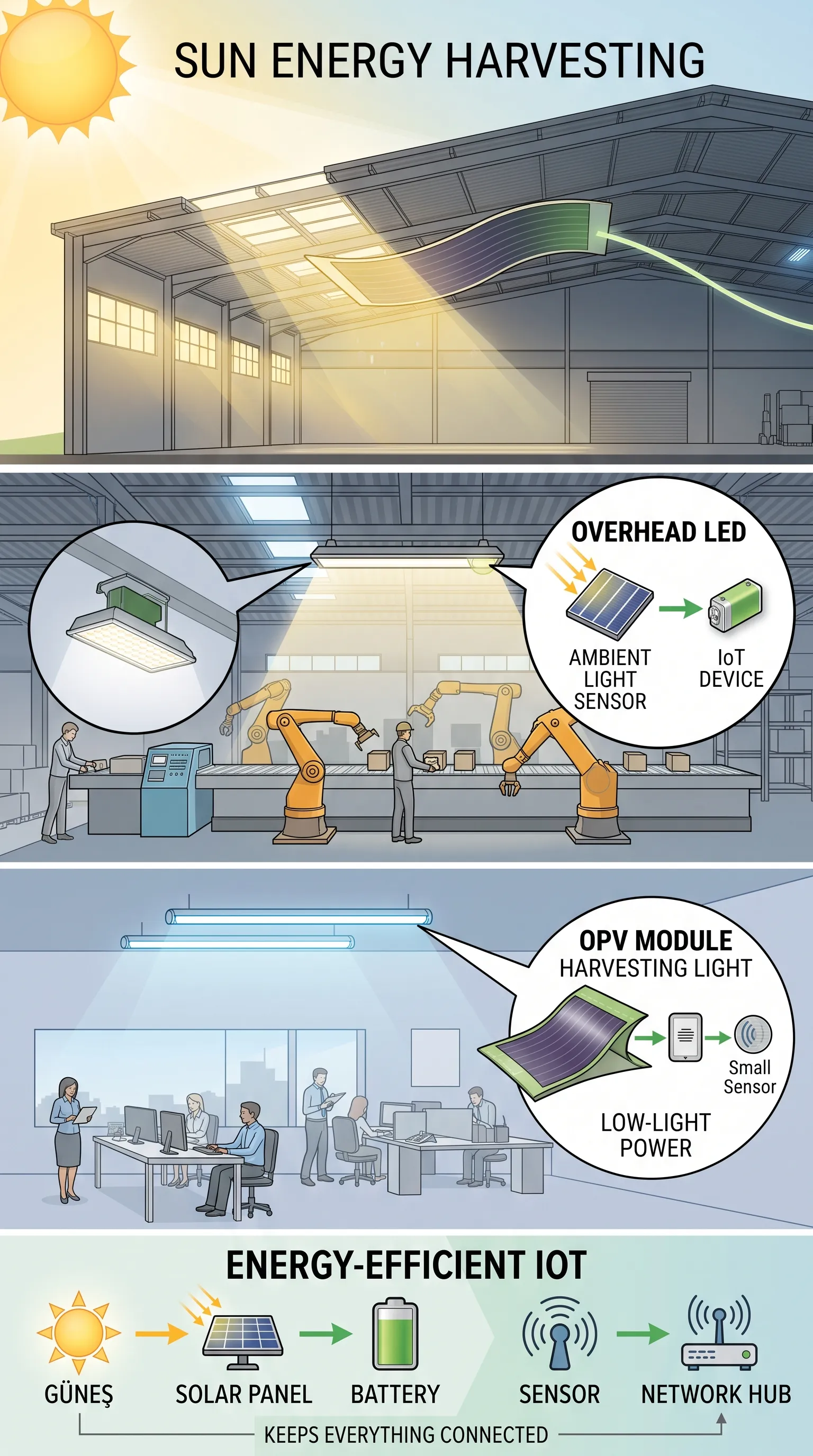
3. Indoor Ambient and Production Lighting (Light)
Check out the comparative performance matrix and field standards of our batteryless sensor technologies on our Technology Performance and Comparison Matrix page.
Request a Batteryless Sensor Project Design for Your Plant
Share your factory’s hot surfaces, vibrating machinery, and lighting conditions with us; our specialized engineering team will deliver a complimentary plant-specific energy harvesting feasibility report and ROI projection.
Frequently Asked Questions
What is energy harvesting and how does it work physically?
Energy harvesting is the technology of capturing, converting, and storing ambient micro-energy sources such as thermal gradients, mechanical vibrations, light, and radio frequency waves emitted as industrial process waste using physical transducers to power wireless telemetry nodes without batteries or external wiring.
What is thermoelectric energy harvesting (Seebeck Effect) and what is its solid-state physics mechanism?
The Seebeck Effect occurs when a temperature gradient is established across p-type and n-type semiconductor junctions, causing charge carriers (electrons and holes) to diffuse from the hot side to the cold side, generating electrical voltage. In industry, this waste heat is harvested directly into DC power by Thermoelectric Generator (TEG) modules.
What are the differences between piezoelectric and electromagnetic (inductive) methods in kinetic energy harvesting?
Electromagnetic harvesting uses a moving mass-coil assembly resonating in a magnetic field, inducing electricity via Faraday's Law of Induction (optimal for low frequencies/high currents). Piezoelectric harvesting utilizes crystal or ceramic lattices that generate electrical charge under mechanical strain and deformation (optimal for high-frequency vibration/high voltages).