In heavy-duty 2-stroke and 4-stroke internal combustion engines operating on commercial vessels, power barges, and land-based biogas/natural gas/diesel power plants, detecting connecting rod bearing failure and wiping in time is a matter of vital operational survival.
However, conventional safety systems widely deployed across industry today lack the capability to catch this critical failure before it escalates into irreversible destruction. In this article, we examine why legacy oil mist detectors fall short, the stages of bearing failure progression, and how CoRoM—the world’s first batteryless, wireless real-time connecting rod bearing temperature monitoring system—delivers a revolutionary solution.
Limitations of Legacy Conventional Systems: Why They Only Deliver “Condolences”
Traditional monitoring systems relied on for decades (such as Oil Mist Detectors and Splash Oil Systems) depend on indirect and primitive detection methods:
- Delayed Signals: Oil mist detectors trigger alarms only after oil vapor concentration inside the crankcase reaches critical thresholds. By the time oil mist forms, the bearing metal has already melted, thermal transfer to the crankshaft has occurred, and micro-welding has commenced.
- Inability to Guarantee Damage Limits: Legacy systems cannot catch the failure at the bearing stage. Consequently, when an alarm sounds, it cannot guarantee whether the outcome will be a crankshaft re-grinding, a complete crankshaft replacement, or catastrophic engine block destruction caused by a thrown connecting rod.
- No Real-Time Action: In essence, legacy systems do not prevent destruction at the source; they merely deliver a message of “Condolences for your loss” to plant managers and chief engineers.
Systems that should issue alerts at the earliest stage—before heat generated at the bearing spreads to the crankshaft and other moving parts—fail to meet modern heavy-duty operational demands.
What is CoRoM? Batteryless & Wireless Real-Time Monitoring at the Source
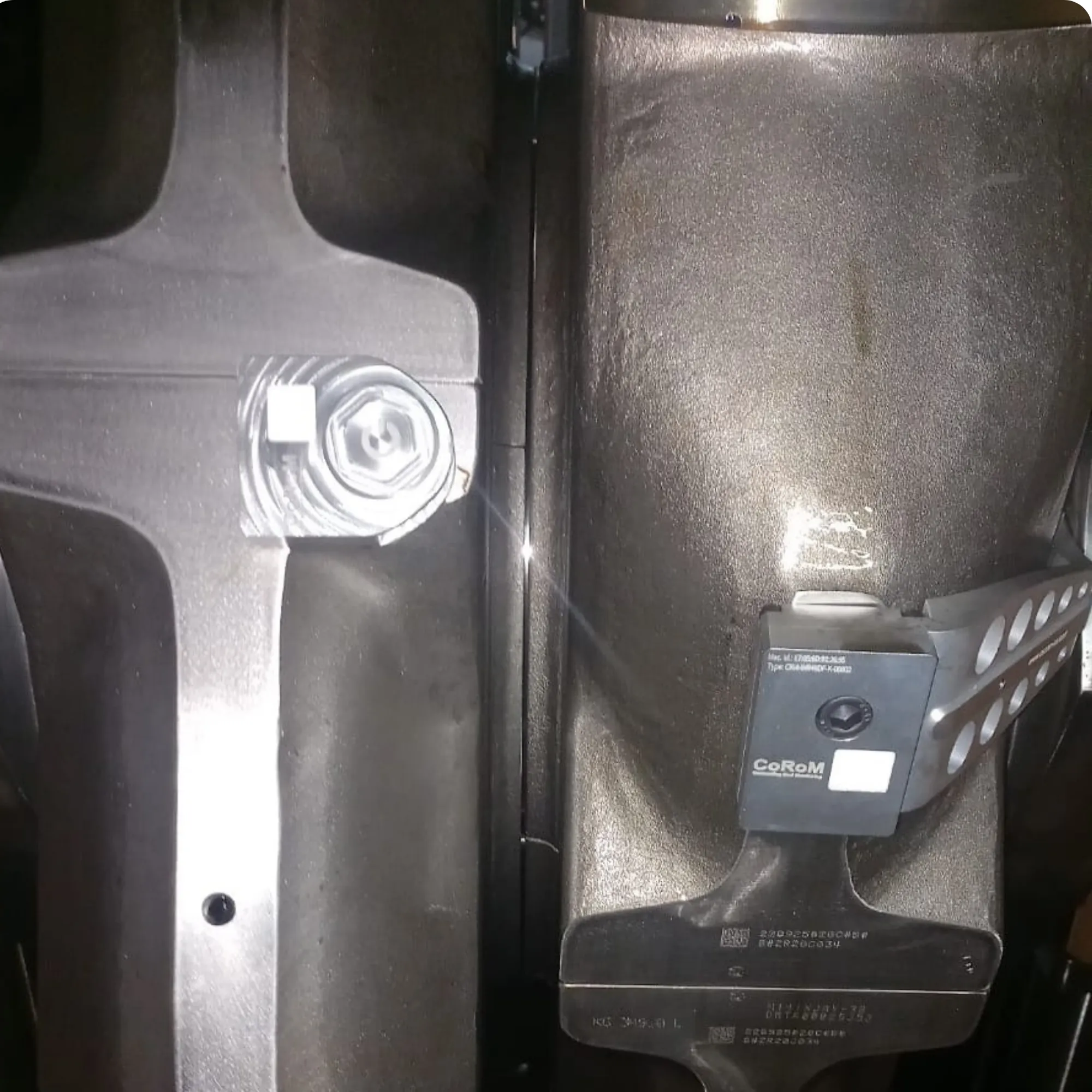
CoRoM is the world’s first batteryless and wireless real-time bearing temperature monitoring sensor mounted directly onto the upper housing of the connecting rod.
It detects thermal anomalies directly at the source, rather than inferring them from crankcase ambient air:
- Connecting Rod Bearing Temperature (Dual-Redundant Sensor Architecture): Measures bearing metal temperature with millisecond precision. The dual-redundant sensor design ensures uninterrupted reliability under extreme conditions.
- Splash Oil Temperature: Simultaneously tracks the thermal profile of oil splashing from above to analyze internal crankcase ambient and lubrication dynamics in real time.
No Cables, No Batteries: Kinetic Energy Harvesting
In crankcase environments where routing cables is impossible and heat destroys chemical batteries, CoRoM generates its operating power from the engine’s natural rhythmic motion (Kinetic Energy Harvesting).
Operating on Faraday’s Law of Induction, its linear generator architecture is expressed by the formula:
E = -N · (dΦ / dt)
Where:
- E: Induced electromotive force (Volts)
- N: Number of induction coil turns
- dΦ/dt: Rate of change of magnetic flux through the coil (Wb/s)
The sensor operates autonomously without battery swaps or maintenance for over 10 years of continuous service.
Adaptable Engineering for Any Engine Type
CoRoM is not limited to a single brand or model. Its modular architecture can be custom-engineered for any engine type and connecting rod geometry:
High-precision telemetry broadcast by CoRoM is gathered by the Wi-Gate Industrial Receiver Gateway mounted on the engine block exterior. Supporting up to 128 sensors, Wi-GaTe seamlessly forwards data to vessel or power plant SCADA, PLC, and AMS systems via RS485, Modbus RTU, Modbus TCP/IP, Profibus DP, and Profinet protocols.
Frequently Asked Questions (FAQ)
1. Why is CoRoM needed when an Oil Mist Detector (OMD) is already installed?
Oil Mist Detectors are reactive systems; they sound alarms only after a bearing has melted and formed oil vapor clouds inside the crankcase. By that point, crankshaft and bearing damage is unavoidable. CoRoM is proactive; it catches thermal spikes at the micro-friction stage long before smoke or oil mist forms.
2. How does a batteryless kinetic sensor function in 100°C+ crankcase heat?
CoRoM contains zero chemical batteries. It converts mechanical engine vibration directly into electrical telemetry power via Faraday’s law. Because it is battery-free, it experiences no thermal degradation in 100°C+ environments and operates autonomously for over 10 years.
3. How is CoRoM telemetry integrated into Vessel Alarm Monitoring Systems (AMS)?
Sensor telemetry is transmitted via BLE (+19.5 dBm) or LoRa (+30 dBm) wireless signals to the external Wi-Gate receiver gateway. Wi-GaTe feeds data into vessel or power plant SCADA, PLC, and AMS panels via RS485, Modbus RTU, Modbus TCP/IP, Profibus DP, and Profinet protocols.
Turn Unpredictable Catastrophes into Truly Predictable Events
If you want real-time data to transform what you thought were unpredictable engine disasters into truly forecastable, preventable events, it is time to meet CoRoM.
To explore our batteryless industrial solutions, examine our kinetic energy harvesting technologies and read our guide on energy harvesting solutions.