Light Energy Harvesting: Photovoltaic Effect and Indoor Energy Conversion
The science of capturing photons emitted from ambient artificial light sources (LED, fluorescent, incandescent lamps) or natural daylight and converting them into electrical energy via photovoltaic cells. An autonomous energy layer enabling low-power electronic systems to operate without external grids or chemical batteries.
Energy Packets of Light: The Power of Photons
Light behaves both as a wave and as a stream of tiny energy packets called photons. When photons strike a surface, they transfer their energy to the atoms of that surface. Light energy harvesting is the process of converting this photon bombardment into an electrical current. Ordinary LED lamps in office ceilings or fluorescents in factory corridors continuously emit billions of photons. Most of these photons are absorbed by walls or floors and lost as waste heat. Advanced photovoltaic harvesting technology captures these lost photons, exciting electrons to create a sustainable micro-current that powers electronic circuits.
The Physical Principle: Photovoltaic Effect and Bandgap
At the core of light harvesting is the photovoltaic effect in semiconductor physics. When photons with energy higher than the bandgap of a semiconductor (such as silicon) strike the material, valence band electrons are excited into the conduction band. This creates electron-hole pairs. The built-in electric field at the P-N junction drives these free electrons toward the n-type region and the holes toward the p-type region, inducing a direct current (DC) voltage.
Differences Between Indoor and Outdoor PV Cell Physics
Monocrystalline silicon (c-Si) cells used in outdoor solar panels are optimized for the broad solar spectrum and high intensity (~1000 W/m²), possessing a bandgap of 1.1 eV. However, under weak indoor LED or fluorescent lighting of 100-500 lux (~1 W/m²), the efficiency of these cells drops to near zero. Indoor light harvesting instead utilizes amorphous silicon (a-Si), perovskite, or organic photovoltaic (OPV) cells. These cells have a wider bandgap (1.7 - 1.9 eV) and are chemically formulated to maximize absorption within the narrow visible light spectrum (400-700 nm wavelength) emitted by artificial light sources.
Technical Constraints
Light Energy Harvesting: Real-World Applications
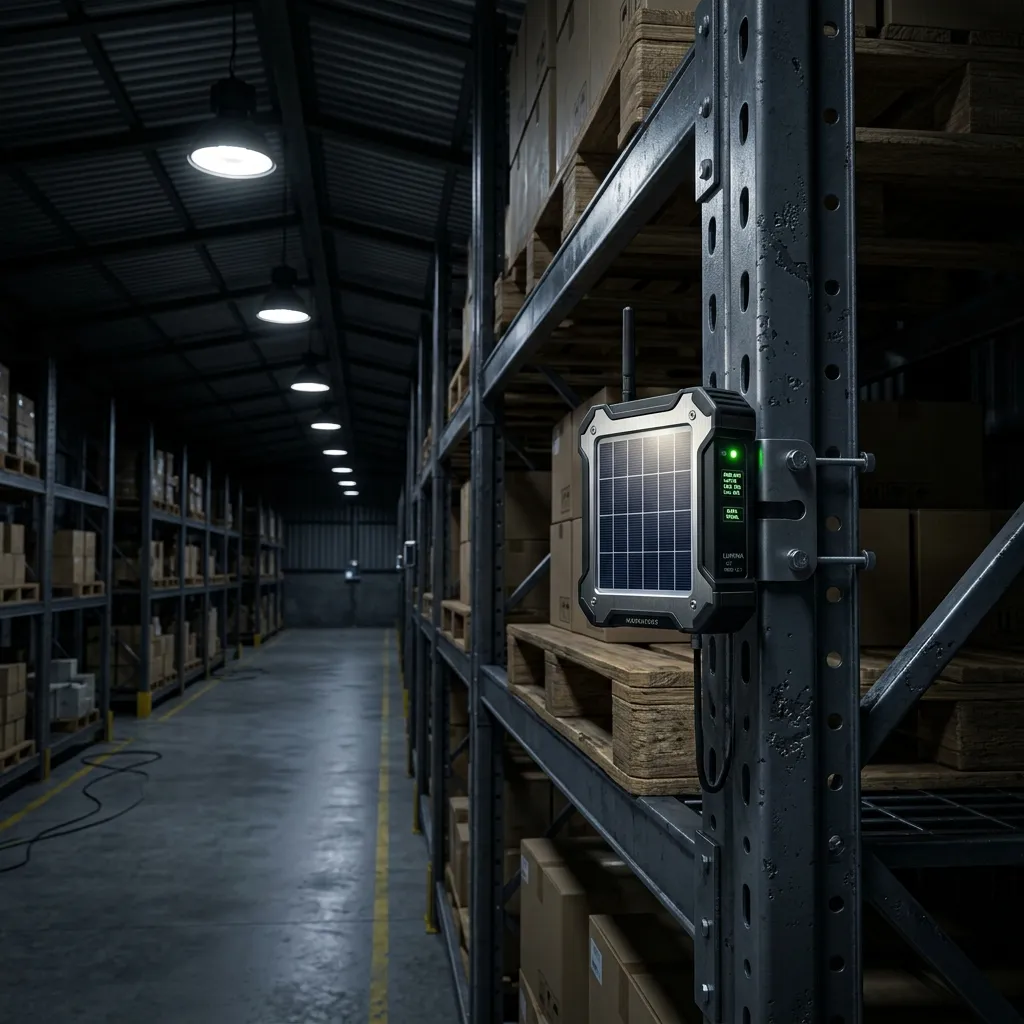
Warehouses & Raw Material Silos: Steady Power from Dim Light
In cold chain logistics warehouses or large raw material silos, ambient overhead lighting is continuously converted into electricity by photovoltaic cells. This harvested power drives sensors monitoring humidity, temperature, and air quality for life without battery changes.
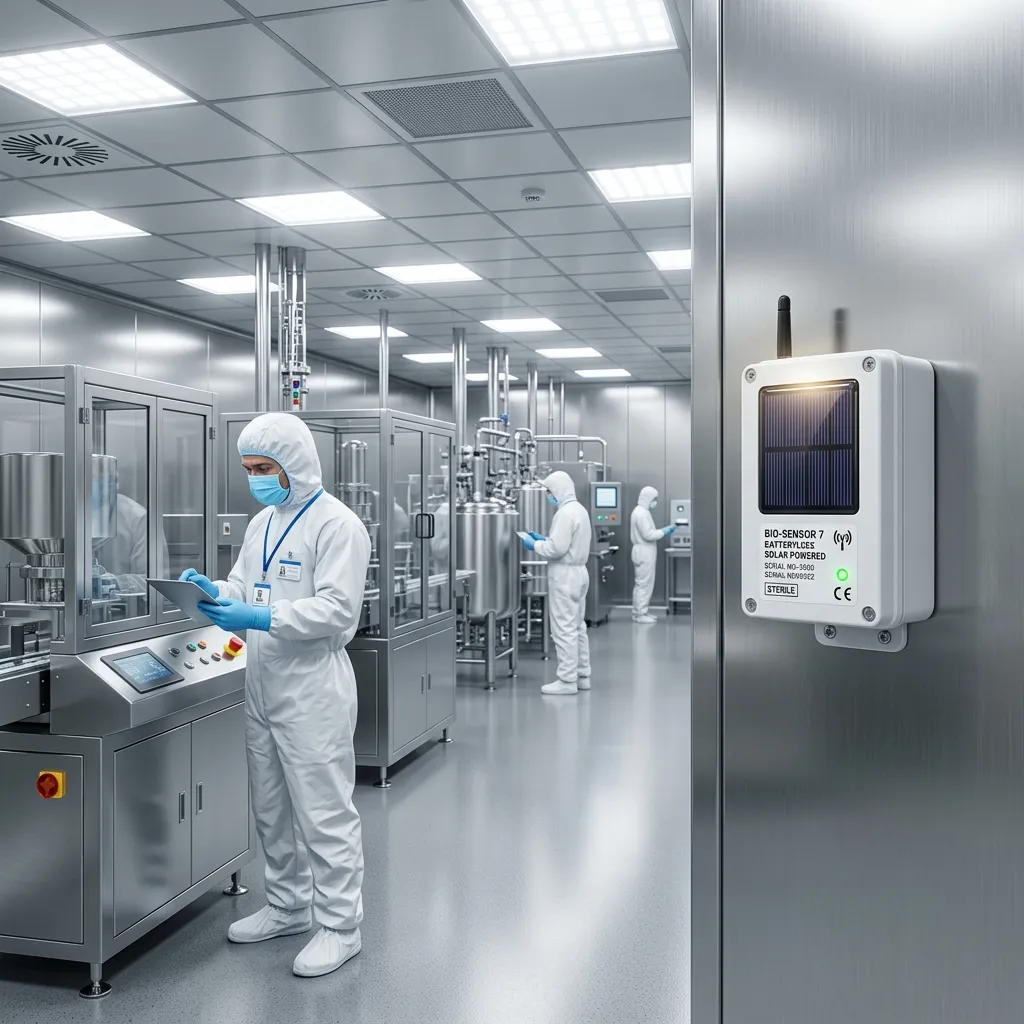
Sterile Zones: Complete Security with Zero Interventions
In pharmaceutical and semiconductor cleanrooms, battery leakage and cable installation pose severe compliance risks. Indoor PV units, harvesting energy from continuous fluorescent and LED lamps, report cleanroom environmental metrics 24/7 autonomously with zero battery changes or entries.
Server Racks: Humidity & Temperature Tracking from Corridor Lights
Adding more cabling inside server aisles of data centers can obstruct optimal air circulation. Autonomous temperature and humidity monitoring sensors, powered by ambient light harvested from aisle lamps, wireless monitor critical rack status.

Compatible Hardware Solutions
AiM
A batteryless smart environmental monitor powered by indoor ambient artificial lighting, tracking CO₂, temperature, humidity, and barometric pressure in real-time.
View Product →AiM-0
A compact temperature and humidity sensor powered by ambient indoor light, capable of maintaining telemetry for up to 7 days in complete darkness via supercapacitor storage.
View Product →Let's Analyze the Ambient Light Potential at Your Plant
Model the lux values of your sterile cleanrooms and storage warehouses with our engineering team to design your otonom telemetry migration.
Technical FAQs on Light Energy Harvesting
What is the primary difference between indoor PV cells and outdoor solar panels?
Outdoor solar panels are designed to capture the broad spectrum (from infrared to ultraviolet) and high energy of direct sunlight. Indoor PV cells (such as amorphous silicon or organic PV) feature a higher bandgap (1.7 eV+) engineered to extract maximum energy from the narrow visible light spectrum (400-700 nm) typical of LED or fluorescent lights.
What is the minimum light intensity (Lux) required for light energy harvesting to function?
Indoor photovoltaic harvesting systems can generate electricity in light levels as low as 50 to 100 Lux, which is typical for dimly lit factory corridors or warehouse aisles. They operate at full performance under typical industrial floor lighting of 200 Lux or more.
Do the systems stop operating when the lights are completely turned off (e.g., during weekends or holidays)?
No. The harvested energy is directly accumulated in solid-state supercapacitors or micro lithium-carbon storage units. When the lights are completely off, this stored energy combined with ultra-low-power deep sleep modes allows the devices to continue transmitting data for 7 to 14 days in complete darkness.