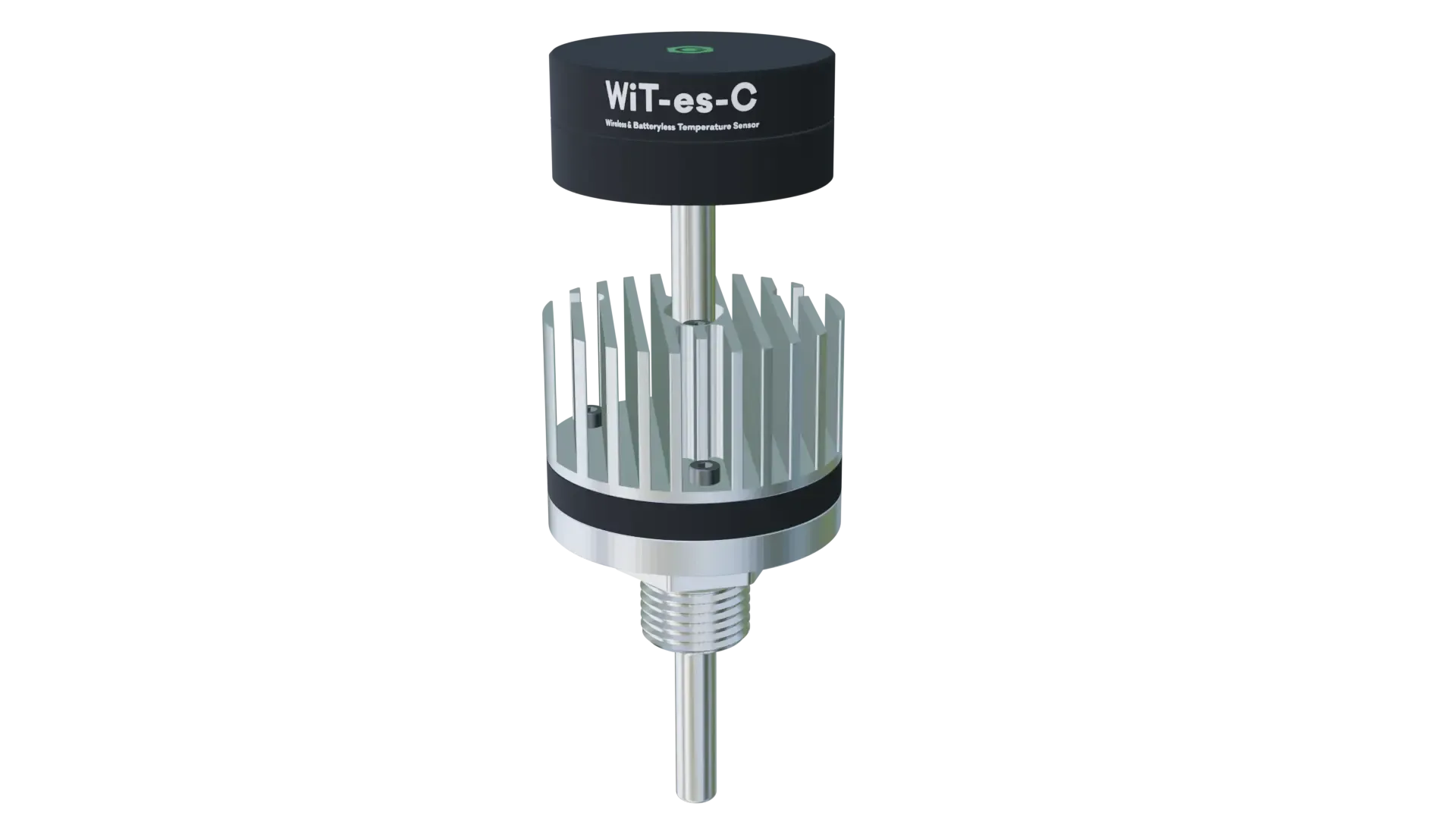
ESCOM-es’s WiT-es product offers a groundbreaking solution with energy harvesting-powered wireless and battery-free technology for temperature monitoring in industrial applications.
WiT-es: Temperature Monitoring
WiT-es is designed to monitor temperature in various industrial environments using a wireless and battery-free sensing node powered by an energy harvesting system. The system transmits data to the main control panel via BLE, creating a preventive, informative, and protective early warning system aimed at minimizing failures in industrial processes.
Key Features and Benefits
- Wireless and Battery-Free: Eliminates the need for wiring and battery replacement, reducing maintenance costs and efforts.
- Energy Harvesting: Uses thermoelectric generators that convert temperature differences into usable energy, ensuring uninterrupted operation without an external power source.
- Real-Time Monitoring: Provides continuous data on temperature levels, enabling fast detection of anomalies.
- Preventive Maintenance: Facilitates early detection of potential issues, offers timely intervention opportunity, and reduces the risk of system failure.
- Easy Integration: Compatible with existing systems and supports various industrial communication interfaces.
Technical Specifications
- Sampling Time: 500 milliseconds
- Processing Time: 500 milliseconds
- RF Transmission Power: +8 dBm
- Power Consumption: 70 - 170 µW
- Power Supply: Thermoelectric Harvester
- Measurement Ranges: -40 to +1200 °C
- Connection Sizes: 1/4” NPT, 3/8” NPT, 1/2” NPT, 3/4” NPT, 1” NPT, 1/4” BSP, 3/8” BSP, 1/2” BSP, 3/4” BSP, 1” BSP
- Data Transmission: BLE, Wi-Fi, Zigbee, LoRa, NB-IoT
Application Areas
WiT-es is ideal for the following areas:
- Power Plants
- Chemical Industry
- Refineries
- Process Engineering
- Plant Construction
- Metal Processing
- Cement Industry
- Glass Industry
- Trash Incineration
The Future of Industrial Monitoring
By adopting WiT-es, industries can achieve smarter, more efficient, and maintenance-free operations. This innovation not only increases operational efficiency but also contributes to a more sustainable and environmentally friendly industrial environment.